
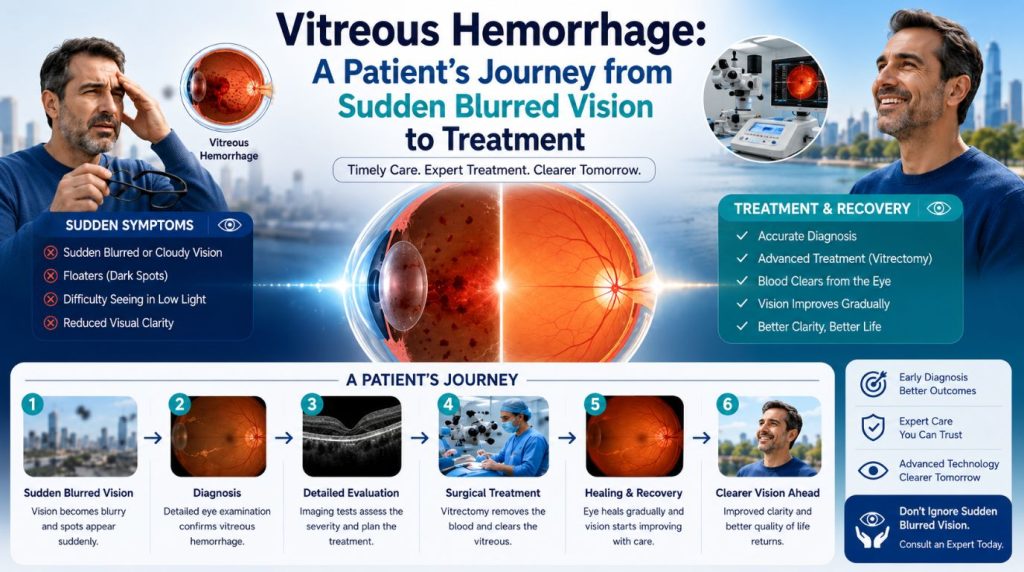
Vitreous Hemorrhage: A Patient’s Journey from Sudden Blurred Vision to Treatment
It started with what the patient described as “dark spots” moving across the vision.
At first, it seemed like ordinary floaters. But within a short time, the vision in one eye became increasingly cloudy. Looking through that eye felt almost like looking through smoke.
There was an obvious question:
💬 PATIENT QUESTION
“Doctor, why did my vision suddenly become so cloudy?”
A retinal examination revealed bleeding inside the eye—a condition known as vitreous hemorrhage.
For the patient, the sudden loss of clear vision was frightening. For the eye specialist, the next priority was to understand something more important:
Where was the blood coming from, and what was happening behind it?
What Is a Vitreous Hemorrhage?
The vitreous is the clear, gel-like substance filling much of the inside of the eye. Normally, light passes through it to reach the retina at the back of the eye.
When blood enters the vitreous, that clear pathway becomes obstructed.
The amount of bleeding can vary. Some patients may notice new floaters, dots, cobweb-like shapes, or hazy vision. With heavier bleeding, vision can become significantly reduced.
But vitreous hemorrhage is not simply “blood in the eye.”
There is usually an underlying reason for the bleeding, and identifying that reason is an important part of treatment.
Finding the Cause Behind the Bleeding
Vitreous hemorrhage can occur in association with different eye conditions, including diabetic retinal disease, retinal tears, retinal blood vessel problems, trauma, and other retinal changes.
This means the same symptom can have very different causes.
💬 PATIENT QUESTION
“Will the blood clear on its own?”
Sometimes blood in the vitreous may gradually clear, depending on the cause and severity. But treatment decisions cannot be based only on waiting for the vision to improve.
The retina behind the hemorrhage also needs attention.
A detailed retinal assessment helps determine the likely source of bleeding and whether there is another condition requiring treatment. When the view of the retina is limited by dense blood, additional assessment may be required to understand what is happening inside the eye.
When Does Treatment Become Necessary?
Not every vitreous hemorrhage is treated in exactly the same way.
The underlying cause, amount of bleeding, condition of the retina, duration of symptoms, and overall eye health can all influence management.
Some cases may be monitored or treated for the underlying retinal condition. In others, surgical treatment such as vitrectomy may be considered.
For the patient, that possibility naturally brings another question.
💬 PATIENT QUESTION
“If the problem is bleeding, why would I need surgery?”
Vitrectomy can be used to remove the blood-filled vitreous and provide the surgeon with access to the retina when surgical management is appropriate.
Importantly, the goal is not simply to clear the blood.
The underlying retinal problem also needs to be identified and managed appropriately.
Inside the OT: Looking Beyond the Hemorrhage
When vitrectomy is required, the surgeon works through very small openings in the eye using specialized microsurgical instruments.
The blood-containing vitreous can be removed, allowing a clearer view of the retina.
🔎 INSIDE THE OT
Clearing the hemorrhage is only part of the procedure. The surgeon’s attention is also on the retina—looking for the source of bleeding and any retinal changes that need treatment.
Depending on the findings and underlying condition, additional treatment may be performed during the procedure.
This is why surgical planning is individualized. Two patients may both arrive with vitreous hemorrhage, but what needs to be done can be very different.
After Treatment: “When Will My Vision Improve?”
Once treatment has been completed, attention turns toward recovery.
💬 PATIENT QUESTION
“Now that the blood has been treated, when will I see clearly?”
Visual recovery varies.
It depends not only on the hemorrhage but also on the health of the retina and the condition that caused the bleeding in the first place. The procedure performed and the way the eye heals can also affect recovery.
Follow-up examinations therefore remain an important part of the journey.
The eye specialist can monitor the retina, assess healing, and determine whether further treatment or observation is required.
The Important Lesson Behind Sudden Cloudy Vision
For this patient, what began as moving dark spots became a reason for a detailed retinal assessment.
That is the important lesson from vitreous hemorrhage.
Sudden floaters or cloudy vision should not simply be assumed to be harmless.
The visible symptom may be blood inside the eye, but the more important question is why that bleeding occurred.
Dr. Sonam Angmo Garg evaluates retinal conditions including vitreous hemorrhage and helps patients understand the cause, available treatment options, and follow-up required for their individual eye condition.
⚠️ WHEN TO GET YOUR EYES CHECKED
If you suddenly develop many new floaters, cloudy or hazy vision, flashes of light, a dark shadow, or a sudden reduction in vision, seek a prompt eye examination.
Sometimes the symptom is only the first part of the story.
Understanding what is happening behind it is what guides the next step.