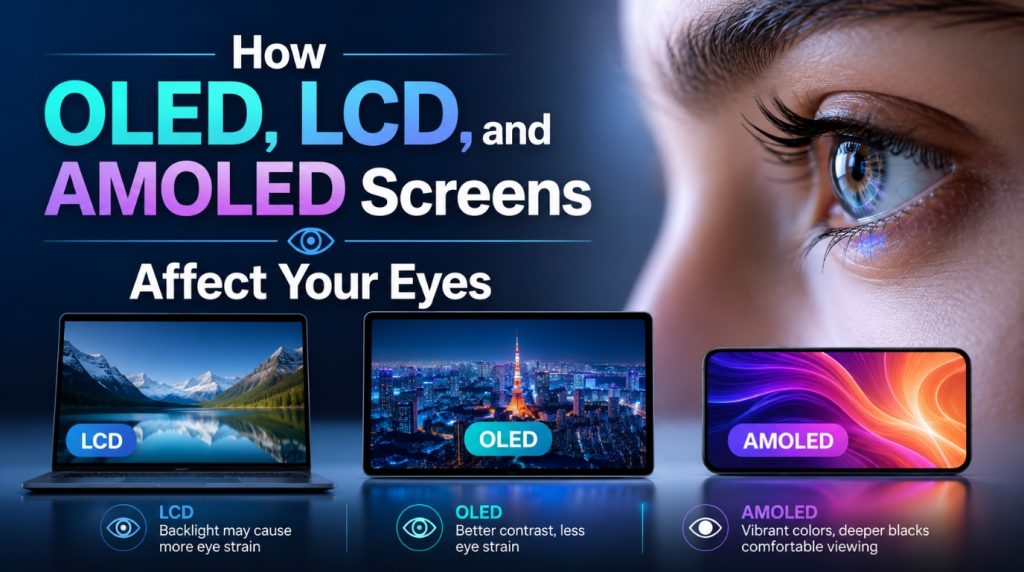
How OLED, LCD, and AMOLED Screens Affect Your Eyes
Smartphones, tablets, laptops, televisions, and wearable devices use different display technologies, including LCD, OLED, and AMOLED. While these screens offer impressive image quality and brightness, many people wonder whether one display type is healthier for their eyes than another.
The truth is that no screen technology has been proven to permanently damage healthy eyes during normal use. However, certain display characteristics can influence eye comfort, especially during prolonged screen time.
Understanding the Different Screen Technologies
LCD (Liquid Crystal Display)
LCD screens use a backlight that shines through liquid crystals to produce images.
Advantages include:
- Consistent brightness
- Good color accuracy
- Widely available
- Often more affordable
However, some LCD screens may produce more glare, depending on brightness settings and screen coatings.
OLED (Organic Light-Emitting Diode)
Unlike LCDs, OLED displays do not require a separate backlight. Each pixel emits its own light.
Benefits include:
- Higher contrast ratios
- Deeper blacks
- Improved viewing angles
- Better energy efficiency when displaying dark content
Because individual pixels can turn off completely, OLED screens often appear more comfortable in dark environments.
AMOLED (Active Matrix Organic Light-Emitting Diode)
AMOLED is an advanced version of OLED technology commonly found in premium smartphones and tablets.
AMOLED displays offer:
- Vibrant colors
- Excellent contrast
- Fast response times
- Thin, lightweight designs
- Improved battery efficiency for dark-mode interfaces
The viewing experience is often smoother, particularly for videos and gaming.
Do Different Screens Affect Eye Comfort?
Eye discomfort is usually caused less by the type of screen and more by how the screen is used.
Factors that commonly contribute to digital eye strain include:
- Long periods of uninterrupted screen use
- Reduced blinking
- Excessive screen brightness
- Glare from surrounding lighting
- Poor viewing distance
- Small text size
Whether you’re using an LCD, OLED, or AMOLED display, these factors have a greater impact on eye comfort than the display technology itself.
What About Blue Light?
All digital screens emit some blue light, although the amount varies depending on brightness, display settings, and content.
Current scientific evidence suggests that the blue light emitted by consumer electronic devices is not known to cause permanent eye damage during normal use. However, prolonged screen exposure may contribute to eye fatigue and can interfere with sleep if devices are used close to bedtime.
Using night mode or reducing screen brightness in the evening may improve comfort for some users.
Understanding Screen Flicker
Some OLED and AMOLED displays adjust brightness using a method called pulse-width modulation (PWM). While many users never notice it, a small number of people may be more sensitive to this type of flicker and report symptoms such as:
- Eye fatigue
- Headaches
- Visual discomfort
Sensitivity varies from person to person, and not all OLED or AMOLED devices use the same brightness control methods.
Tips to Reduce Digital Eye Strain
Regardless of your screen type, healthy viewing habits make the biggest difference.
- Follow the 20-20-20 rule.
- Blink frequently while using digital devices.
- Keep the screen about an arm’s length away.
- Adjust brightness to match ambient lighting.
- Reduce glare by repositioning your screen.
- Increase text size for comfortable reading.
- Take regular breaks during prolonged work sessions.
- Limit screen use before bedtime when possible.
Frequently Asked Questions
Which screen is best for your eyes: OLED, LCD, or AMOLED?
No display technology has been proven to be universally better for eye health. Comfort depends more on viewing habits, brightness, glare, and individual sensitivity than on the screen type itself.
Do OLED screens damage your eyes?
Current evidence does not show that OLED screens permanently damage healthy eyes during normal use. Extended screen time may still contribute to digital eye strain.
Is dark mode better for eye comfort?
Dark mode may improve comfort for some users, particularly in low-light environments. However, preferences vary, and readability should always take priority.
Can screen time cause permanent vision loss?
Current research indicates that prolonged screen use does not cause permanent vision loss, but it can lead to temporary symptoms such as dry eyes, blurred vision, and eye fatigue if regular breaks are not taken.